
Medical PCB Assembly & PCB Provider wit Strict Safety Regulations
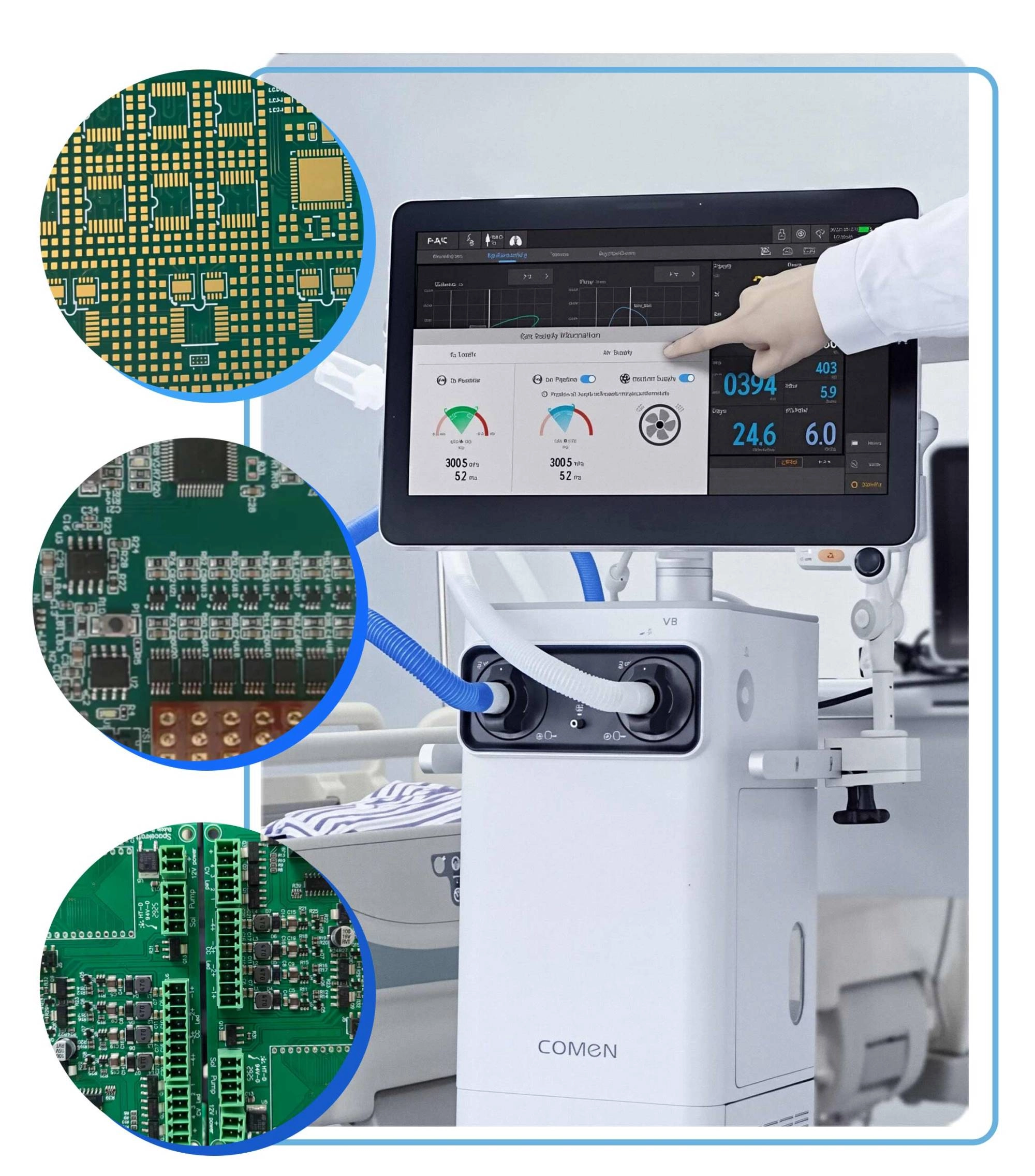
Medical & healthcare devices push PCB design toward high reliability, ultra-low noise, and long-term stability.
|  | ||||||||
--Signal Integrity, Safety Isolation, Miniaturization, and Reliability Under Continuous Use
Different medical applications combine different demands in noise sensitivity, miniaturization, safety isolation, thermal stability, and long-term reliability.
Learn How We Solve Your Design Challenges
Application Scenario | Design Challenges / Functional Needs | Required PCB Capabilities (Industry-Specific) |
Wearable Health Monitors |
- Ultra-low noise for biosignal accuracy | - HDI & fine-pitch routing |
| - Compact, lightweight form factor | - Low-noise analog layout | |
| - Continuous bending & motion | - FPC with high bend cycles | |
- Low-power operation
| - Ultra-thin stackups | |
Portable Diagnostic Devices |
- Stable analog front-end | - Controlled impedance for analog paths |
| - Clean sensor interfaces | - RF/digital coexistence optimization | |
| - Isolation between power + measurement paths | - Shielded stackup structures | |
- EMI from wireless modules
| - High-accuracy routing | |
Patient-Care & Monitoring Systems |
- Long-term reliability (24/7 operation) | - High-isolation stackups |
| - Safety isolation (patient-contact circuits) | - Reinforced creepage/clearance | |
- Power integrity for sensitive analog loads
| - PI-optimized copper planes | |
Medical Imaging Electronics (Ultrasound/ECG/EEG) |
- Ultra-low noise channels | - Low-loss materials |
| - High channel counts | - Low-noise multilayer stackups | |
| - EMI sensitivity | - EMI shielding layers | |
- Temperature stability
| ||
Lab & Clinical Instruments |
- Chemical/thermal stress | - High-Tg, stable laminates |
| - Long device lifetimes | - Reinforced via structures | |
- High-precision control electronics
| - Copper balancing for stability |
These are industry requirements, not capabilities—they define whether medical PCBs are stable, safe, and accurate over time.
 | Medical-grade PCBs require stackups built for:
|
Request a Free Design Consultation
The exact engineering checks we perform for medical-grade reliability, safety, and signal accuracy
|
|
|
|---|---|---|
| Noise affecting biosignal accuracy | Analog return paths, grounding strategy, sensor routing | Ensures clean ECG / EEG / PPG / biopotential signals |
| Layout-induced sensor drift | Trace symmetry, shielding, dielectric stability | Maintains long-term measurement accuracy |
| Patient-safety isolation risks | Creepage spacing, leakage paths, dielectric thickness | Meets medical safety and regulatory requirements |
| Wireless interference with analog channels | Antenna placement, RF keep-outs, coexistence zones | Prevents dropped data and measurement corruption |
| Mechanical failures in wearable flex zones | FPC bend radius, via spacing, mechanical reinforcement | Improves lifetime in motion-heavy wearable devices |
| Thermal instability affecting measurements | Copper balancing, heat-path design | Reduces drift caused by localized heating |
| Power instability in sensitive analog loads | Decoupling strategy, PI return paths | Avoids noise injection into analog front-end circuits |
|
|
 |  |
Proven by 7 industries, 4000+ customer projects
Please contact us at sales@knownpcb.com, ask for engineering support here or use the form below to reach out to KnownPCB | Get In Touch Today |








 MEDICAL PROBLEM WE SOLVE
 WHAT WE CHECK
 WHY IT MATTERS
 Improved accuracy of optical sensors (PPG / SpO₂) through routing cleanup
 Stabilized isolation barriers in patient-contact designs
 Reduced EMI coupling between RF modules and biosignal inputs
 Increased flex-life reliability in wearable medical devices
 Prevented thermal drift in high-precision diagnostic circuits
 Improved signal consistency in multi-channel ultrasound boards