
Blog & Design Guide

When we viewed from the HDI PCB manufacturing side, the quality for HDI board construction affects not only electrical behavior, but also the stability of hybird HDI board in actual printed circuit board production.
For manufacturable HDI boards, this stability is reflected in more than routing completion, it also depends on:
1. Copper balance and stack symmetry for HDI stackup
2. HDI board prepreg selection
3. Core thickness of HDI PCB
4. Material selection for HDI board structure
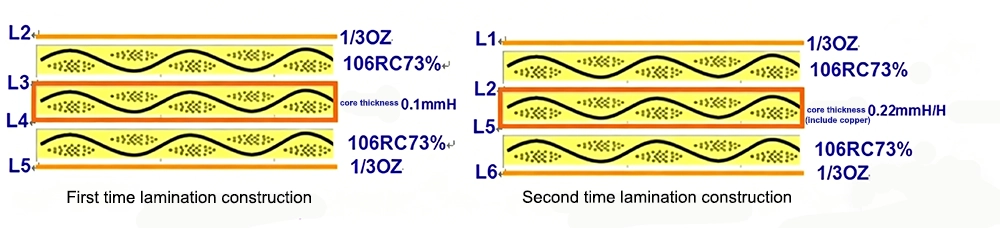
Copper balance and stack symmetry are the foundations of physical reliability for a high-end HDI PCB. Copper distribution and symmetry can directly impact on:
1. Lamination performance (prevention of Bow/Twist)
2. HDI board flatness (Board warpage control)
3. Overall HDI PCB manufacturing stability
Some HDI stackups may look complete and good in the HDI circuit board design, but an insufficient structural balance can still result in avoidable stress problem during the production of HDI board.
In this case, the issue is no longer whether the HDI circuit board can be routed, but whether it can remain mechanically stable after fabrication and assembly process.
In hybrid HDI board stackups, prepreg provides dielectric isolation between HDI layers. The resin content of prepreg and prepreg’s flow characteristics influence the filling performance in etched regions and complicated copper features during lamination of bare HDI circuit board.
What’s more, The dielectric thickness defined by prepreg selection also determines the aspect ratio for microvia plating and filling reliability.
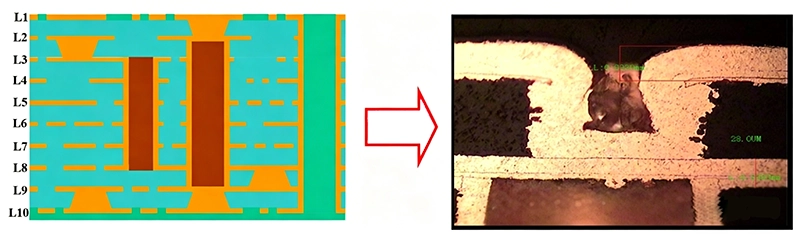
Material selection should be evaluated as a part of the HDI stackup, especially in high-speed and high-density HDI PCB designs. In practice, materials with Dielectric Constant (Dk) around or below 3–3.5 and Dissipation Factor (Df) below 0.01woxy are commonly better when lower loss and more stable signal behavior are required.
For example, some IPC-4101 material classes are specified at Dk ≤ 3.7 and Df ≤ 0.009 at 1 GHz, which is showing that the dielectric performance is a cratical part of HDI stackup planning.
A manufacturable HDI board is not defined only by routing completion.
It also depends on whether the stackup can support balanced structure, stable reference conditions, reliable lamination behavior, and consistent production quality.
For the complete overview behind the topic about HDI stackup, see our main article: Why Stackup Is the Starting Point of a Manufacturable HDI Board.
Request for a tech support
October/09/2026ENIG Nickel and Gold Thickness: Drawings, XRF, and Reports
September/01/2026LED Aluminum Core PCB Design to Manufacturing
July/23/2026PCB Common DFM Mistakes and Solutions

September/06/2026High Current PCB Design: Current Paths, Copper, Vias & Thermal Limits
July/03/2026Single Sided PCB Board: How to Design and Purchase
Proven by 7 industries, 4000+ customer projects
Please contact us at sales@knownpcb.com, ask for engineering support here or use the form below to reach out to KnownPCB | Request a Manufacturing QuoteInclude your quantity, target delivery date and key requirements. File handling and NDA information. |