
Get A Quote
CN
Recently, KnownPCB has completed a 4-layer high-frequency PCB project with FR-4 and Rogers materials hybrid lamination structure.
This multilayer hybrid high-frequency board supports both high-speed signals and general functional circuits, it should ensure the electrical performance and the design of this hybrid high-frequency PCB must also consider the stability of manufacturing and cost control at the same time.
Therefore, the hybrid lamination technology is the critical part in this high-frequency PCB fabrication.
About this hybrid structure high-frequency PCB:
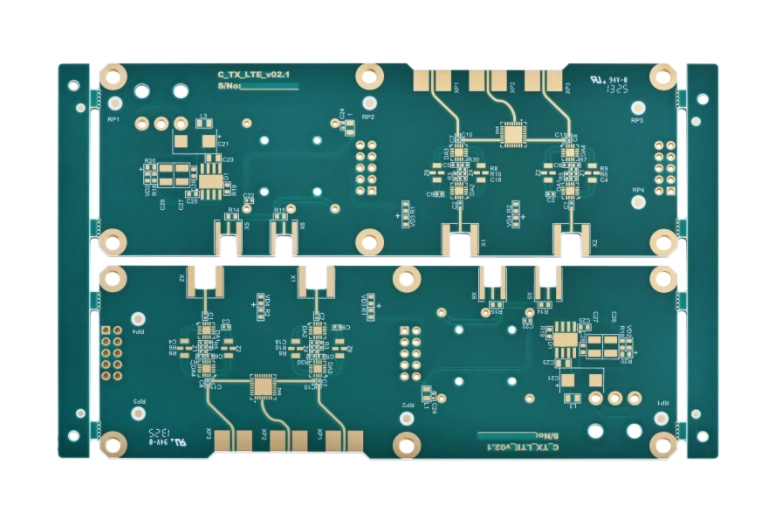 |
Base Material |
FR-4 + Rogers |
|
Layers |
4 |
|
|
Dimensions |
- | |
|
PCB Thickness |
1.69mm |
|
|
Board Solder Mask Color |
Green |
|
|
Silkscreen |
White |
|
|
Surface Finish |
ENIG |
View more Product Line | View more Project Solution
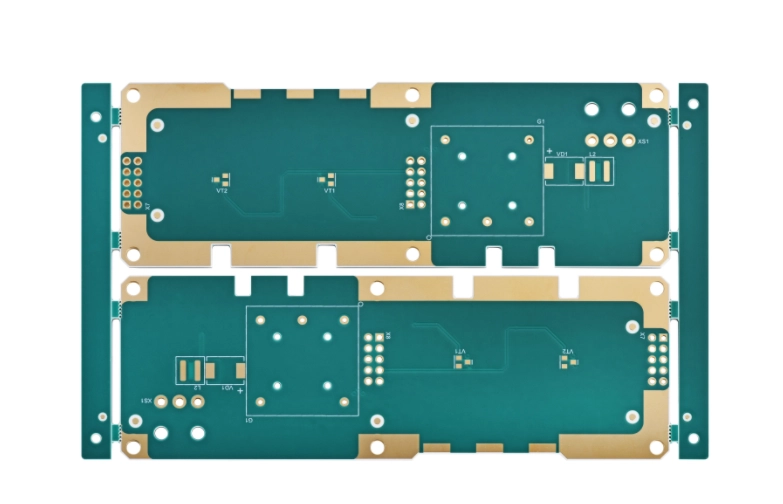
For more comparison between Rogers and FR-4, please read Rogers® vs. FR-4 Materials
As the result, by using FR4-Rogers hybrid lamination, a high-frequency PCB can achieve an optimal balance between high-performance and cost control.
However, due to the differences in dielectric constant, coefficient of thermal expansion (CTE) and mechanical performance between FR-4 and Rogers, the difficulty of stackup design and manufacturing control of a high-speed and high-frequency is significantly increased.
1. The differences in material CTE will result in PCB warpage (bow and twist) and distortion.
Learn more about PCB warpage
2. It is difficult to control interlayer bonding strength, which can lead to the risk of PCB delamination.
3. Tolerance deviation of dielectric thickness will affect the stability of impedance.
4. In the multilayer high-frequency structure, layer-to-layer misalignment will be amplified and have impact on the performance consistency of overall RF circuit board.
During the pre-prduction stage, KnownPCB reviewd the CTE of FR-4 and Rogers materials. By controlling and optimizing the lamination temperature, pressure and thermal cycling curves, we have reduced the accumulation of internal stress between FR-4 and Rogers, and the risk of this RF board warpage.
According to material characteristics, we have choosed suitable bonding solutions and lamination parameters to ensure a stable bonding between FR4 and Rogers materials.
In the DFM review, KnownPCB has controlled the thickness of critical high-frequency layers and optimized material distribution based on impedance requirements, so as to ensure superior and stable transmission performance of high-frequency signals.
We have reduced the offset effects that caused by material expansion and contraction through engineering compensation, lamination control and high-precision alignment management.
The 4-layer high-frequency PCB with hybrid FR-4 and Rogers materials has achieved stable transmission of high-frequency signals, and at the same time has prossessed good electrical performance and long-term mechanical reliability.
Request for a tech support
April/29/2026The Pad Consistency for The Fine-Pitch BGA PCB
October/23/2026EV Inverter Gate Driver PCB: Local Loops and Isolation
June/09/202610A Battery Current-Sense PCB
September/10/2026Do You Need Controlled Impedance PCB Manufacturing
September/03/2026ENIG vs HASL: Which Surface Finish Is Right for Your PCB?