
Get A Quote
CN
Industrial Test PCB |
||
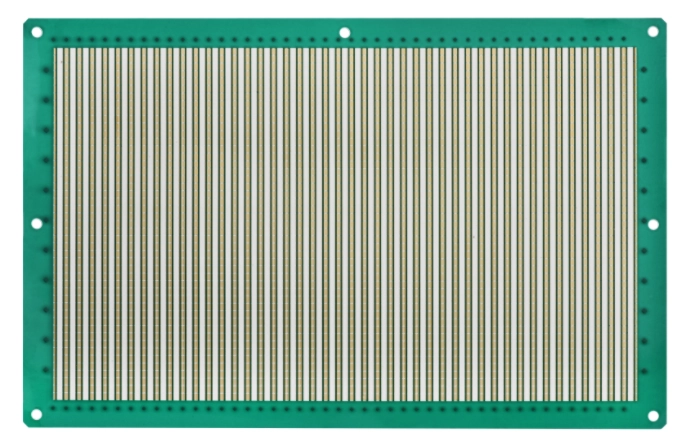 |
Base Material |
R3003 |
|
Layers |
2 |
|
|
Dimensions |
211*135 |
|
|
PCB Thickness |
0.65mm |
|
|
PCB Color |
Green |
|
|
Silkscreen |
White |
|
|
Surface Finish |
ENIG |
|
|
Special Technics |
20mil line/space |
|
View More Product Line | View More Project Solution
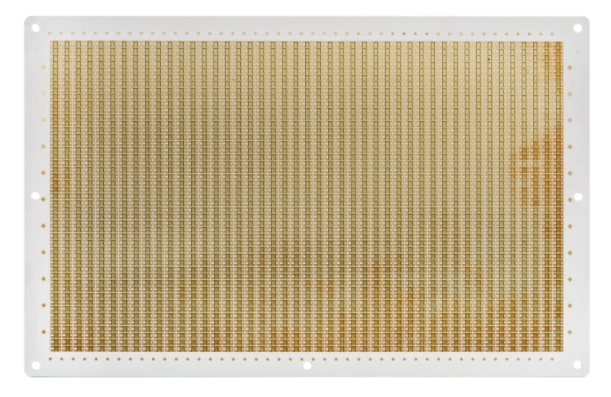
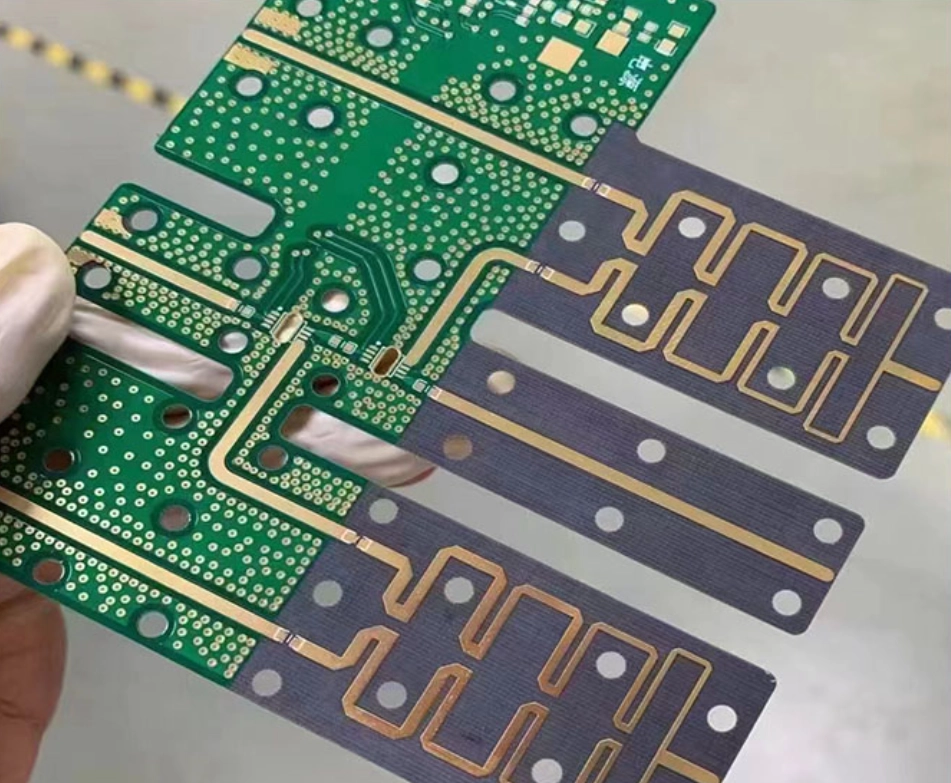
In RF PCB design, Rogers ' selection of four of the most classic high-frequency board materials follows a clear performance-oriented logic.
The RO4350B is the top choice for cost-effectiveness. It has a stable dielectric constant ( Dk=3.48 ) and extremely low loss. It adopts an epoxy glass cloth lamination process similar to FR4 , which makes it easy to mix with low-cost FR4 . It is widely used in commercial 5G and base station power amplifiers. Its disadvantage is that its coefficient of thermal expansion is different from that of FR4 . In mixed-plate applications with extreme temperature cycling, long-term reliability needs to be considered.
The RT/duroid 5880 is known for its ultra-low and consistent dielectric constant ( Dk=2.20 ) and near-zero loss factor, making it an ideal choice for millimeter-wave circuits, 77GHz automotive radar, and high-speed phased array antennas, ensuring stable signal transmission phase and minimal loss. However, its disadvantage is that it is relatively soft in mechanical strength, requiring particularly precise process control during multilayer board lamination and drilling, otherwise it is prone to deformation.
The RT/duroid 6002 offers a medium dielectric constant ( Dk=2.94 ) and near-perfect temperature stability, with an extremely low Z- axis coefficient of thermal expansion. It is designed for multilayer boards in harsh environments such as aerospace and defense, where high reliability is required. Its main drawbacks are the very high material cost and the fact that its ceramic filler properties cause significant wear on drilling tools, which also increases processing costs.
RO3003 performs well in temperature-sensitive circuits such as filters and low-noise amplifiers due to its excellent dielectric constant temperature stability and low cost. However, its high hardness makes it more tool-intensive than materials like 5880 when drilling and milling PCBs , and its process compatibility with FR4 is not as good as RO4350B .
In the field of aerospace RF PCBs , in addition to Rogers , the most commonly used substrate suppliers in China and their typical series include: Shengyi Technology 's SH260 series , Fotech 's Raystar series , AGC Taconic 's TSM-DS3 series, and polyimide ( PI ) substrates. Compared to Rogers' RT/duroid 6002 (dielectric constant Dk ≈ 2.94 , excellent temperature stability but high cost and poor processability), Shengyi Technology's SH260 , as a representative product of a leading domestic enterprise, performs excellently in extreme high-temperature scenarios such as spaceborne power management due to its superior high-temperature resistance ( Tg up to 250 ℃) and reliability passed NASA's gas venting test. Taizhou Wangshenling Ruilong series, with its stable dielectric constant ( Dk=2.65-6.15 selectable) and optimized high-frequency loss characteristics ( Df as low as 0.0015 ), provides cost-effective RF solutions for domestic satellite communication systems and radar modules. AGC Taconic TSM-DS3 excels in low loss and high thermal conductivity, making it suitable for high-power applications such as spaceborne phased array antennas.
Request for a tech support
March/18/2026Via-in-Pad Resin Plugging in High-Voltage PCB
September/03/2026ENIG vs HASL: Which Surface Finish Is Right for Your PCB?
April/22/2026How Do Via Stubs Affect Signal Integrity in High-Speed PCB?

March/17/2026Heavy Copper PCB with Complex Shape Machining for High-Current Applications
April/21/2026Uniform plating in Heavy Copper PCB