It is not necessary that electronics products go from bench prototypes to full production. The design team needs PCB boards as well as supply chain, assembly, inspection, and test to be survived in a controlled build. Well, prototype assembly PCB vs low volume PCB assembly is key here.
First of all, let’s talk about prototype PCB assembly.
It sees if the schematic, layout, package, and firmware are compatible on a board. The point is that the design might have unverified nets and might not have been tested and resolved for IC behavior, thermal zones, or layout, even if all of these met specs in CAD.
How can we forget speed of learning here? Hand rework, jumper wires, alternate components, and/or partial test coverage is all okay for engineers, but the thing is: board should strictly answer technical questions. The fact to be kept in mind is that the goal at this stage is not polished production unit but evidence that the design direction is fine.
The following are some applications of prototype PCB assembly.
Let’s consider an example here.
Suppose a board uses a new MCU, switching regulator, and high-speed interface. The prototype stage is actually there in order to verify the behavior of booting, rail sequencing, current consumption, noise margin, and the basic communication before you order more boards.
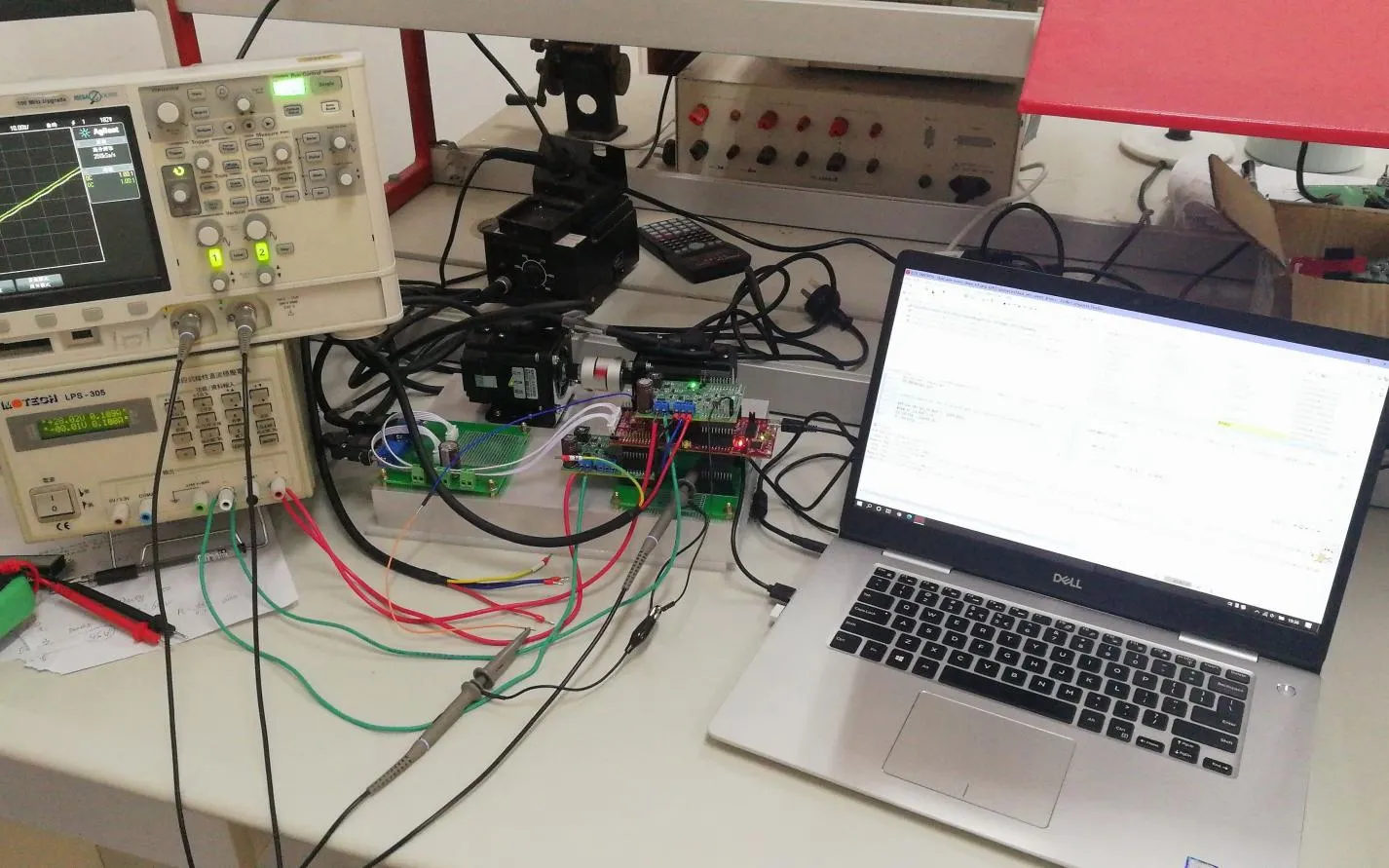
Prototype-stage validation and debugging
Now comes the time to mention low volume PCB assembly.
If the PCB design is more solidified, then comes this type of assembly that refers to a small batch production process. The number is small but the mindset is different. The team does not ask just simple questions. It can think beyond and inquire, “Can this board be assembled, inspected, tested, packaged, and repeated in a safe manner with controlled variation?”
What about documentation? It is upgraded. BOM includes the following information: Approved manufacturer part numbers, alternates, life cycle, moisture sensitivity, and sourcing risk.
Not only that, but before release, check the following information: Centroid file, Gerber data, assembly drawing, polarity marks, test points, panelization details, and inspection criteria.
Now, the following are some applications of low volume PCB assembly.
This is also the stage when engineers are able to monitor yields, causes for rework, substitution of parts, soldering behavior, and test patterns. Do you know the direct benefit of it for yourself? No doubt, this allows you to sidestep unnecessary bills before you scale.
A PCB NPI (stands for New Product Introduction) process goes through the following stages.
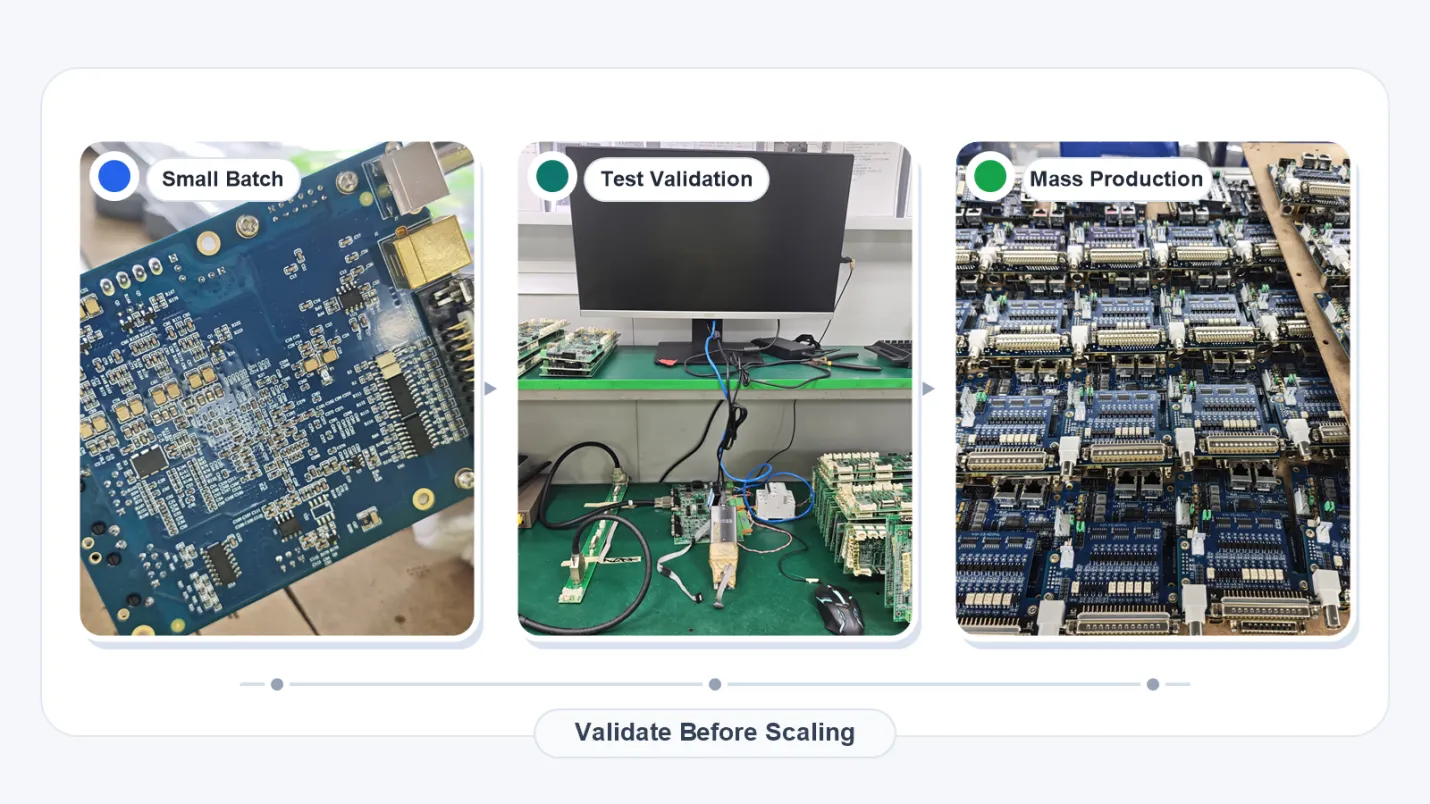
Never forget the standards in any case. As an example, we would like to mention two standards here. First, the IPC-A-610 specifies acceptance criteria for electronic assemblies. Second, IPC-J-STD-001 specifies criteria for soldered electrical/electronic assemblies.
The IPC J-STD-001J was released in March 2024 and included the feedback from participants in about 27 countries. The purpose of its mentioning here is to inform you that the electronics industry is outspreading its coordination regarding soldering requirements.
Prototype testing is just like investigative. But what is investigated here? Actually, power rails, clock signals, loading of firmware, programming headers, thermal rise, connector orientation and communication buses are some of the areas that engineers check. We also want to mention that the test setup is manual, and the reason is that the design changes after each lab session.
What is the handy output? It is diagnosed detail. Let’s suppose that the board fails to make it through the test but shows the wrong pull-up values, unstable power sequencing, wrong package orientation, insufficient copper area, or timing issues related to the firmware; it is still helpful.
When we talk about low volume testing, more structured is the thing. The process involves solder paste inspection, AOI, X-ray for hidden solder joints, flying probe, functional test, programming, serialization, final visual inspection, and ICT. But you have to use ICT very carefully. We recommend to employ it only when the fixtures are justified.
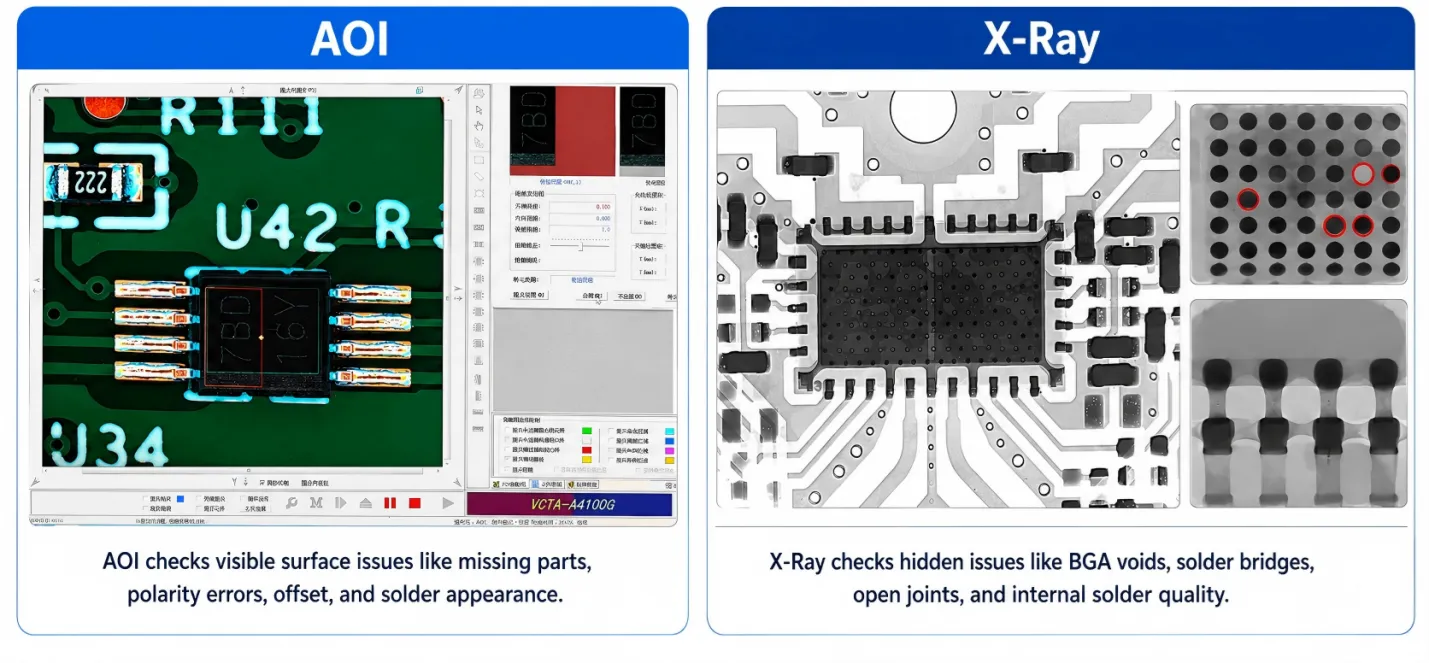
Test plan and board risk should always be corresponding. For simple LED controller, AOI and functional tests can be enough. But for dense BGA board, medical device controller, industrial gateway, or RF product, further inspection and traceability are needed. Yes, you can also use X-ray to inspect through-hole solder conditions that cannot be inspected by other means.
There is no doubt that prototype assembly is cheaper. Yet, this is not the actual benefit of it. The reason perk is basically the learning speed. The team is paying for the following information.
In comparison to this, low volume PCB assembly has a totally different cost structure. There are different factors that take more time and attention. These might be programming machines, making the stencil, setting up the process, kitting parts, planning for tests, routing the inspection, and creating production documentation. Preparation effort is increased, but this is not the whole story. Repeated defects, which could be dozens (or hundreds) of boards, are decreased.
We would want to give you a quick idea about cost. A low volume PCB assembly run with just 50 pieces can cost $1-$2 per board in the context of fixed NRE or setup costs. You know what? That is before considering fabrication, components, placement, inspection, testing, and shipping.
Let’s take an example of soldering temperature. SAC305 lead-free solder reflows at 217-220°C. But this is not the peak reflow temperature, as it can even exceed. In a prototype, one successful reflow result is sufficient for further debugging. On the other hand, in the case of a low volume batch, the reflow profile needs to be more controlled. Its reason? Tombstoning, voiding, insufficient wetting, and thermal stress affect different assemblies at the same time.
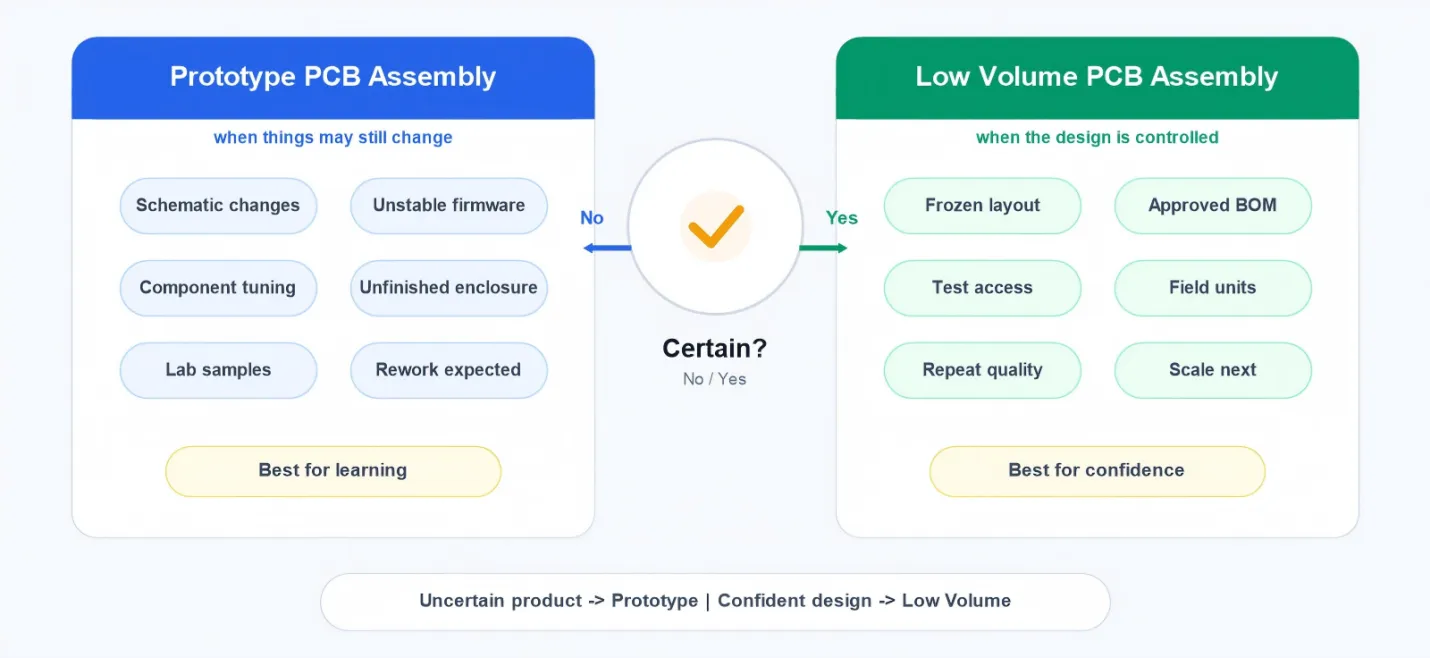
Encountering any of the following cases? Opt for prototype PCB assembly.
Things are not certain? Choose prototype PCB assembly to save money as well as provide engineers with space for learning, not as if the product was ready to be produced under control.
Going through any of the following cases? Go for low volume PCB assembly.
Confident with design but need confidence in manufacturing? Low volume assembly is good.