
Blog & Design Guide

Choosing between IPC Class 2 and IPC Class 3 starts with the consequences of a potential failure. IPC Class 2 is used for products that need dependable performance and a long service life, but can tolerate a service interruption. While for IPC Class 3, continued operation is critical and necessary.
There are some certain categories that usually need Class 3, such as life-support devices, aerospace and defense systems, or automotive safety components. It can also matter on a factory floor. One failed controller may stop the whole production line. A board in a remote installation may be inexpensive, but getting someone out to replace it is another story. And devices operating in extreme environments (such as high temperatures and humidity), vibration and shock matter too.
Still, Class 3 is not necessary for every product. For example, imposing Class 3 on consumer electronics products which are replaced every two years would simply double the cost. Similarly, for industrial-grade products with high annual usage volumes and high cost sensitivity, insisting on a Class 3 standard would reduce the yield by approximately 5–10%.
The following summary highlights some key changes in manufacturing process. Remember these changes should depend on the specific requirements of your project.
| Parameter and Applicable Structure | Class 2 | Class 3 | IPC-6012F Reference |
|---|---|---|---|
| Minimum average hole-wall copper thickness — through-holes, applicable blind vias, and buried vias spanning more than two layers; excludes microvias | 20 μm | 25 μm | Section 3.6.2.11; Table 3-10 |
| Minimum copper thickness in thin areas — same hole structures as above | 18 μm | 20 μm | Section 3.6.2.11; Table 3-10 |
| External annular ring — plated holes without both filling and cap plating | Up to 90° breakout permitted, subject to conductor-junction, clearance, and other applicable requirements | Minimum 50 μm; up to 20% local reduction permitted for specified isolated imperfections | Section 3.4.2; Table 3-7 |
| Internal annular ring — plated holes | Up to 90° breakout permitted under specified conditions; minimum 25 μm when filleting or keyholing is not used | Minimum 25 μm | Section 3.6.2.9.2; Table 3-7 |
| Minimum copper cap thickness over filled holes — when cap plating is specified in procurement documentation | 5 μm | 12 μm | Section 3.6.2.11.2; Table 3-13 |
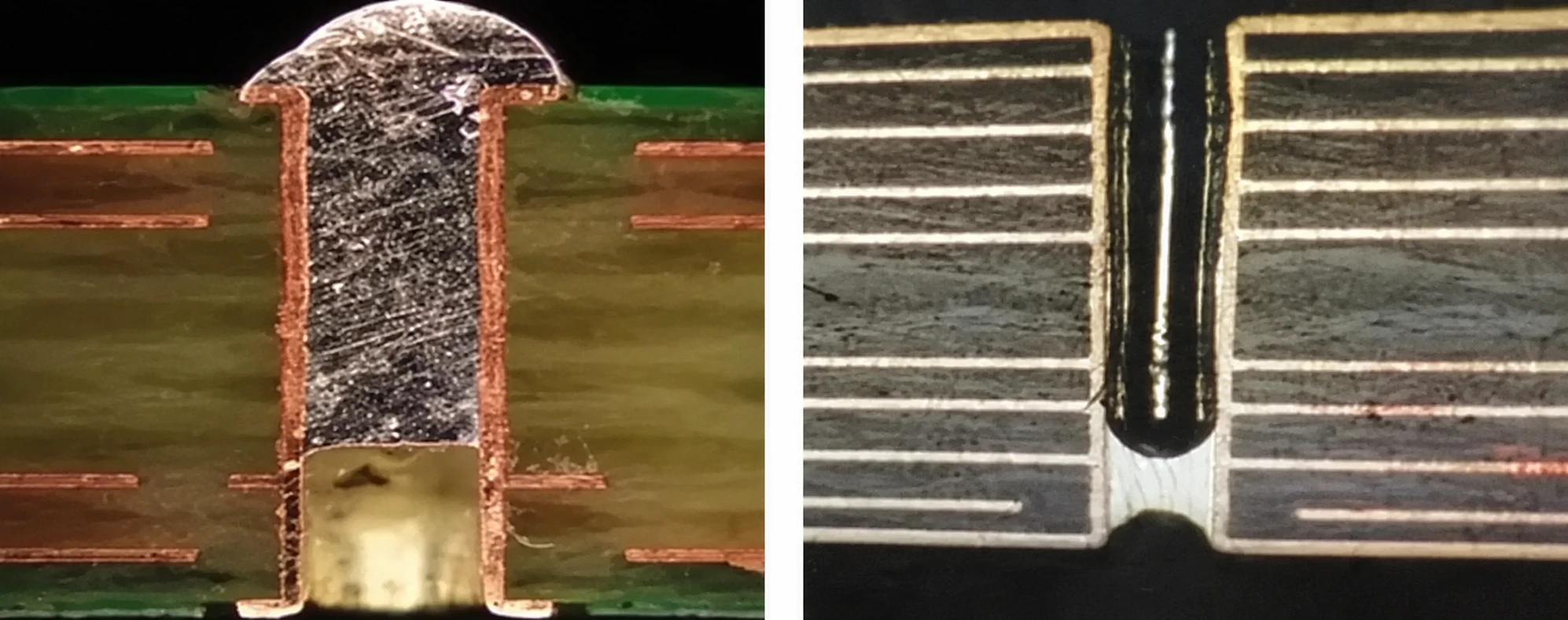
Plated-through-hole microsection showing hole-wall copper and inner-layer connections.
Upgrading a 4-layer pcb board layout from IPC Class 2 to Class 3 might not require a complete redesign, but you cannot skip a targeted design and PCB manufacturing review. If the current layout including pad and via structures, manufacturing margins, meet the requirements of the target standard, it's not necessary to upgrade. If the margins are insufficient, some minor changes to pad diameters or local traces may be required. PCB material selection, supplementary reliability tests, and production lead times depend on specific projects. Facing an IPC standard transition? Get in touch with us today for a professional assessment.
Can a 4-layer PCB meet IPC Class 3 requirements?
Yes. Layer count does not determine the IPC class. A 4-layer board can be manufactured and inspected according to Class 3 requirements. Class rating depends on the specific PCB layout design, manufacturing controls, and inspection testing, not on board complexity.
Does upgrading to Class 3 always require a material change or tighter impedance tolerances?
Not necessarily. Your PCB laminate material selection, layer stackup, and controlled impedance tolerance should be determined by product performance, operating environments, and customer specifications.
What is the difference between IPC-6012, IPC-A-600, and IPC-A-610?
IPC-6012 defines the qualification and performance requirements for rigid printed boards. IPC-A-600 outlines visual bare PCB inspection and acceptability criteria for internal and external board features. IPC-A-610 focuses on solder joint acceptability and electronic assemblies. They suit different subjects and serve distinct purposes, never substitute one for another.
Do PCB and PCBA share the same IPC Class 3 definitions?
No, they are different. Bare PCB quality control focuses on substrate materials, conductors, hole copper plating thickness, and internal layer connections. PCBA quality control checks component mounting, solder joints, and overall assembly quality.
Can I upgrade a finished Class 2 PCB lot to Class 3 via additional testing?
No. a board cannot be reclassified as Class 3 simply by changing its labels, you must review the original PCB manufacturing requirements, testing reports, and verify whether the finished boards meet all Class 3 criteria.
April/15/2026Why Stackup Is the Starting Point of a Manufacturable HDI Board

May/13/20268 Layer PCB Manufacturing and DFM Guide
March/30/2026The Definition of Through Via, Blind Via, Buried Via
April/16/2026High-Current Heavy Copper Design & Manufacturability
October/21/2026Flex PCB Supplier Evaluation: Check the Construction
Proven by 7 industries, 4000+ customer projects
Please contact us at sales@knownpcb.com, ask for engineering support here or use the form below to reach out to KnownPCB | Request a Manufacturing QuoteInclude your quantity, target delivery date and key requirements. File handling and NDA information. |